
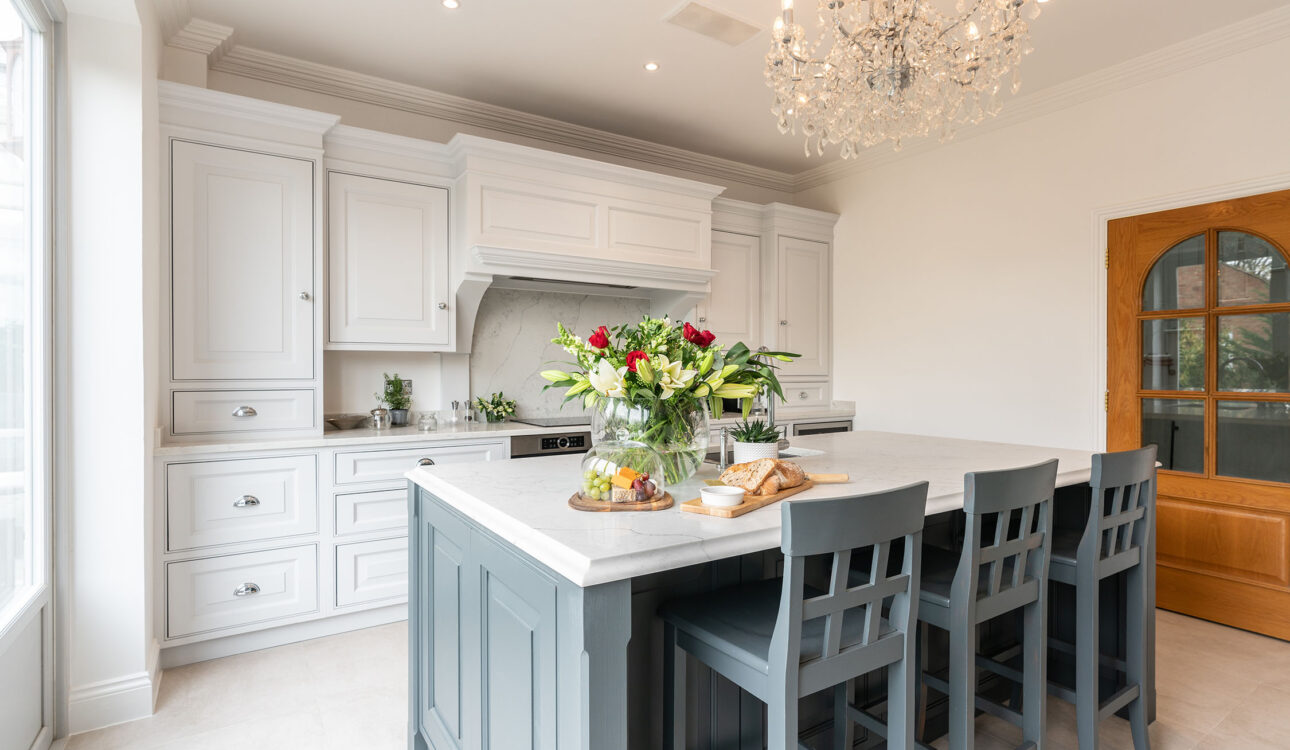
People choose a colour first. It is the wrong order. The door profile does most of the work of setting the style; the colour sets the mood. A white Shaker and a white flat panel are two different kitchens. So choose the door, then the finish, then the colour, and the rest of the decisions get easier.
The three families
Flat panel. A plain slab, edged all round. The door of most modern, minimalist, Scandinavian and Japandi kitchens. Cheapest to make, fastest to clean, and the one that lets a timber grain or a strong colour do the talking. Most finger-pull systems belong to this family: a rail sits on a flat door, or a J-pull is machined into a flat board one.
Shaker and profiled. A frame around a centre panel. The Shaker is the plainest version, with a square frame and a flat panel, and it is the door of most Hamptons and farmhouse kitchens, and the starting point for traditional ones, which add beads, raised panels and mouldings. Our materials page shows all 96 Polytec profiles we work with, grouped from minimal to heavy.
Fluted. Vertical coves or ribs across the whole face, made in 21 mm only and never in gloss. We use it on islands, bar fronts and feature panels rather than whole kitchens, and we have the flutes programmed at order so they line up across doors and drawers.
18 mm or 21 mm
Most kitchen doors are 18 mm thick. We order Shaker and profiled doors in 21 mm wherever the profile allows, because to our eye the extra 3 mm gives the frame a deeper shadow line and a door that feels solid in the hand. It adds about a tenth to the price of the door. On a flat panel the difference matters less, and 18 mm is fine.
Finishes that last
Thermolaminated doors, which is what Polytec’s range is, are a vinyl skin pressed over a machined moisture-resistant MDF core. They take any profile, they wipe clean, and they do not chip the way a painted door can. Heat is their enemy: we fit deflector strips beside ovens, and a kettle steaming under an overhead will lift any vinyl door. A damaged door is replaced, not repaired, which is why we keep the Polytec order numbers: a single door can be reordered years later. Gloss shows every fingerprint. Matt and woodgrain show fewer, and a dark colour shows them in any finish, so test a sample. If fingerprints matter to you, a flat door in a fingerprint-resistant board such as Polytec Venette is the answer. Painted two-pack doors give you any colour in the world and a beautiful surface, at a higher price and with a chip risk in a working kitchen; they are also the only finish that can be touched up in place. They are sprayed for us by a spray shop, and we quote them by hand. Real timber veneer is the most beautiful of all and asks the most care: sun changes its colour suddenly and unevenly, though a north-facing window will fade a vinyl door too.
Matching the door to the house
Our rule of thumb: flat fronts for a new build, an apartment, or any house with polished concrete and black window frames. Shaker for a character home, a Hamptons house, or anywhere with timber floors and high ceilings. Fluted for the island in either. When in doubt, look at the style pages: each one names its door.
Where to from here
When you have a shortlist, bring it to a consultation and we will have the samples on the bench.