What makes a kitchen traditional
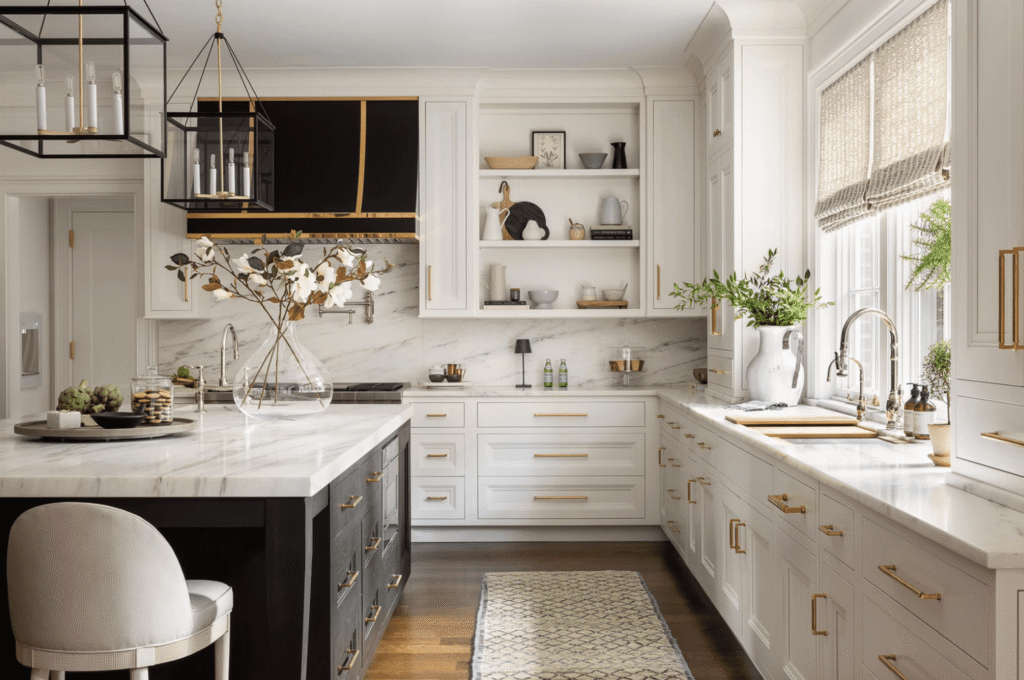
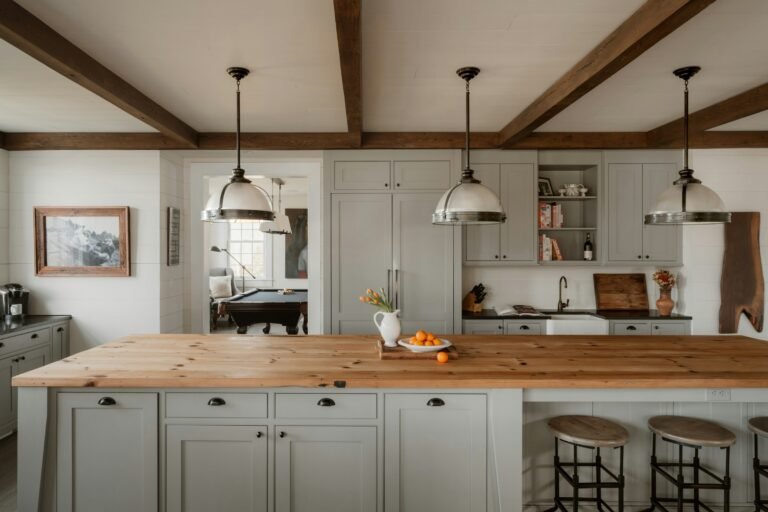
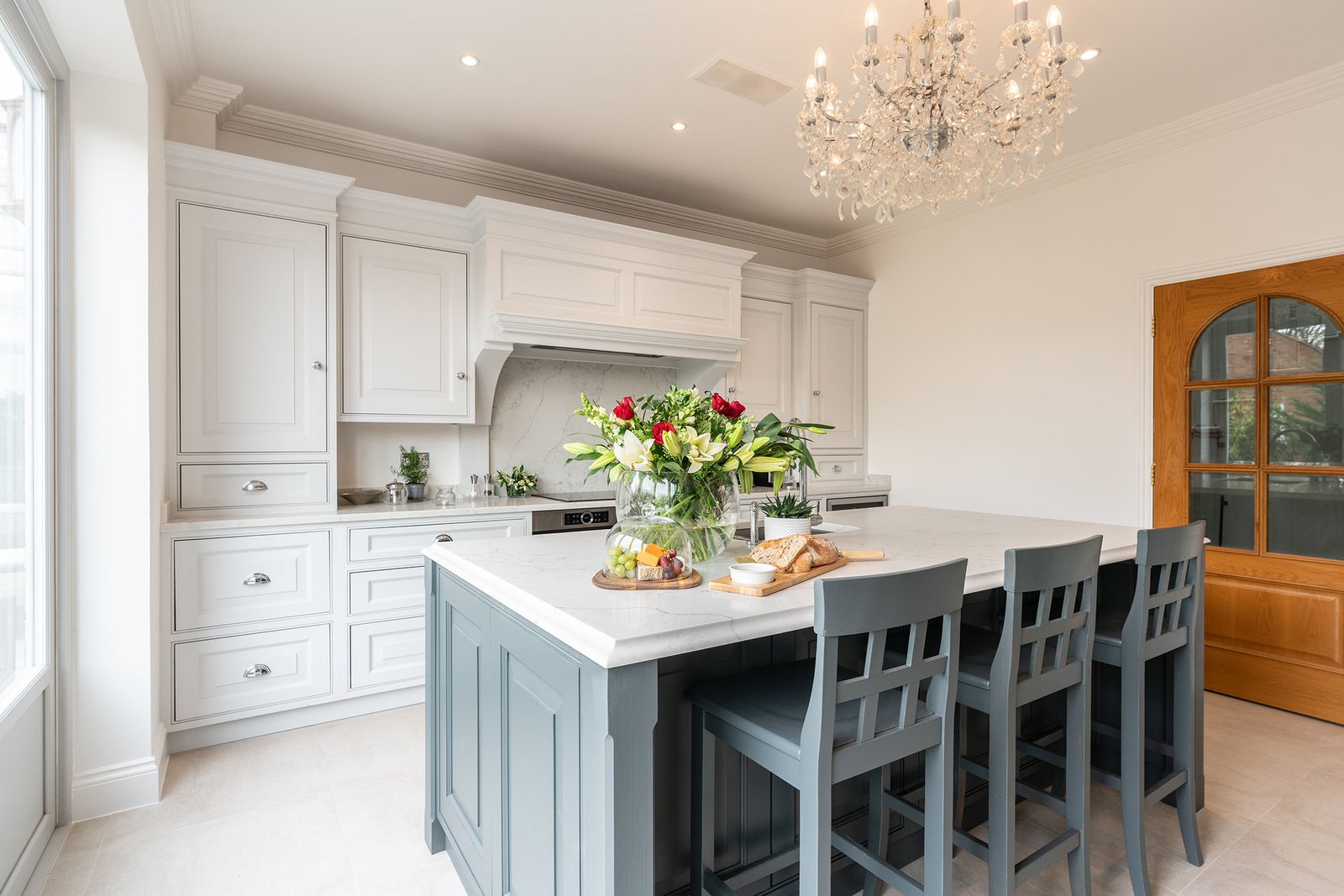
A traditional kitchen is built the way kitchens were built before the flat door took over: as furniture. The edges have a bead. The rangehood is hidden in a mantle with a cornice on it. The island is painted a different colour, because in a house like this the island was once a table. The kitchen above is the English version of that idea, in a soft grey with a blue-grey island and a chandelier, and it is the most formal room on this site.
Where Hamptons is plain, traditional is ornament: a raised or beaded panel, a cornice, a mantle over the cooktop, a painted island in a deeper colour. We build it the way nearly every Australian kitchen is built, frameless, with the door sitting over the box, and we put the ornament where you see it: in the door, the mouldings and the mantle. The English in-frame kitchen, with the door set inside its frame, is a special build we can talk about, but it is not what the Perth market asks for and it is not what we quote by default.
How we build it
The doors are Polytec’s heavy detailed thermolaminated profiles in 21 mm, Hampshire, Chiswick, Briar or Rothbury, in a matt or smooth finish that reads as paint and holds its shape in a Perth summer better than painted timber. They sit on the face of the cabinet, and a moulded frame around the run does what an in-frame kitchen’s frame would. If you want a true painted kitchen, we build the doors in MDF and have them two-pack sprayed by a spray shop, with a coat of honesty about maintenance.
The mantle is built as a piece of joinery around a concealed rangehood, with a moulded cornice, a panelled front and a shelf if you want one. The island is where the colour goes: a blue, a green, a charcoal, always deeper than the walls. Benchtops are a 20 mm slab built up to a 40 mm edge, profiled rather than square, so the bench reads as a thick top. Hardware is polished chrome or nickel, cup pulls and knobs, and we position them on the frame of the door, not in the middle of the panel, which is the detail that separates a proper traditional kitchen from a look-alike.
Tall cabinets are taken to the cornice and finished with a moulding, so there is no gap above them. Glazed doors, if you want them, are a Polytec Door Frame with the glass set in, or a Modernform door with the glass ordered separately.
In a Perth home
This is the kitchen for the house with a history: the federation home in Mount Lawley or Peppermint Grove, the 1920s bungalow in Nedlands, the limestone house in Fremantle. High ceilings, cornices, timber floors and a formal dining room are its natural setting, and a traditional kitchen will look as if it was always there.
It is the wrong style for a small room or a low ceiling: the frames, the mantle and the cornices need height and width to breathe. In a compact character house we’d point you to Hamptons, which keeps the Shaker door and drops the weight.
What it costs
A traditional kitchen from us typically lands between $45,000 and $65,000 for the joinery: designed, made in our Malaga workshop and installed. Benchtop stone, appliances and the trades are separate bills, and we say what they are on the pricing page. It is our most expensive style per metre, and honestly so: the mantle, the cornice mouldings and the panelled island are all hours in the workshop; the thick profiled edge is on the stone bill. The chandelier is yours to fall in love with.